
Bellamy Ghazi
Name Bellamy Ghazi
Position Teacher
Character Information
| Gender | Agendered/Non-Binary | |
| Species | Human | |
| Age | 40 |
Physical Appearance
| Height | 5'9" | |
| Weight | 135lbs | |
| Hair Color | Dark brown | |
| Eye Color | Brown | |
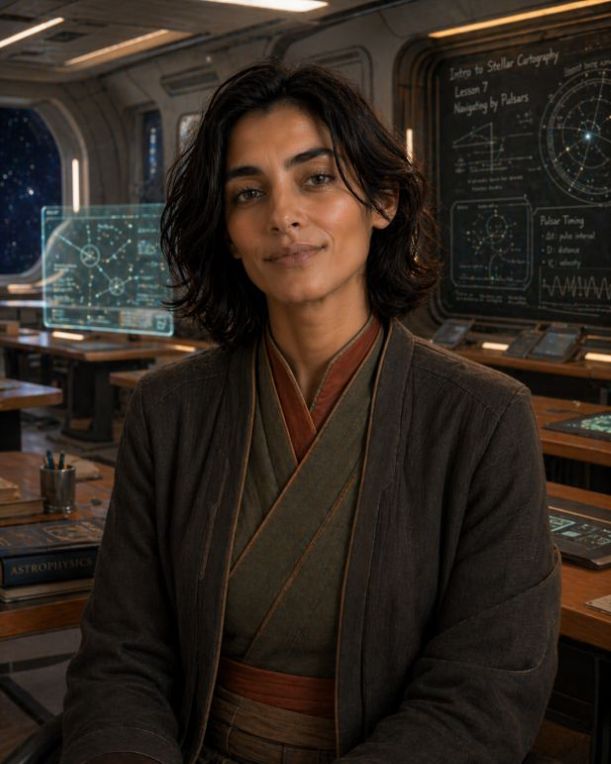
| Physical Description | Bellamy is of average height, wiry in the way that someone with a lot of energy has. They wear their dark brown hair a little longer, usually around jaw length or brushing the collar, with enough length that it can fall forward or be pushed back out of the way. It has a slight wave to it and rarely looks too carefully arranged, usually ending up a little untidy as the day goes on. Their smile is warm and quick, more often a crooked little thing than anything broad, but it changes their whole face when it appears properly. Bellamy has expressive brown eyes and a face that is often easy to read, especially when they are amused, worried or trying not to show they are annoyed. Their skin is light olive in tone, and they tend to dress for comfort and practicality before anything else. Off duty they favour soft layers, worn knits and clothes they can actually move in, and on duty they usually end up looking at least a little lived-in by the end of the day, with sleeves pushed up, hair falling loose and some trace of the schoolroom still on them. |
Family
| Father | Captain Karim Ghazi, retired | |
| Mother | Admiral Ana Hendricksen |
Personality & Traits
| General Overview | Bellamy as a teacher is a warm and deeply people-focused person, who enjoys being around people. They’re the sort of person who enjoys being active, who enjoys interactions and tends to always be writing something down when they’re not talking or listening. They are imaginative, practical and the sort of person who can calm down a rowdy classroom by clapping their hands and telling children to calm down. They are able to one moment sit on the floor with a crying six -year-old or give a teenager the respect of being spoken to properly. They are kind, but not delicate. Bellamy has a strong backbone, a stubborn streak and a very definite sense of what matters. They can be patient through a lot of noise, tears and confusion, but they have far less patience for adults who are careless, dismissive or willing to treat people as acceptable collateral. They are not afraid to stand their ground, and rank alone has never been enough to impress them into silence. They care a great deal about fairness, continuity and making people feel safe without talking down to them. They can be flexible about methods, but much less so about ethics. Bellamy understands that hard choices sometimes have to be made, but that does not mean they are willing to stay quiet about them. Civilian teacher or not, they are more than capable of giving even a Captain a piece of their mind if they think it is deserved. |
|
| Strengths & Weaknesses | Strengths: Bellamy is honest and with that honesty can make people trust them. They are a good listener and able to empathise with different people. Their stubbornness is also a strength, since it makes them fight harder for what they believe is right. Weaknesses: Bellamy can be disruptive in a Starfleet setting despite having been raised in it, so they should know better. They also sometimes think they can get away with saying things because they are not in Starfleet, even if they still need to follow the rules. |
|
| Hobbies & Interests | Bellamy enjoys holodeck programmes, especially free climbing programmes, along with music, art and reading. They play the clarinet, have a particular interest in ancient cultures, and will almost always choose hot chocolate when given the option. |
| Personal History | Bellamy Ghazi was born in 2349 aboard the USS Cairo, the only child of two Starfleet officers. Their mother served in Operations, sharp-minded and exacting, with a gift for command that would eventually take her to the captaincy. Their father was a science officer, warmer in manner but no less ambitious, the sort of man who inspired loyalty without ever lowering his standards. They were both bridge officers with eyes on the Captain’s chair. Bellamy was raised within that world completely. Their earliest years were spent moving between ships and stations, including the USS Thessaly and later the USS Venture, growing up among changing quarters, changing classrooms and the constant expectation that adaptation was simply part of life. They learned how to settle quickly, how to make friends fast and how to recognise the difference between adult reassurance and adult worry. Like many Starfleet children, Bellamy grew up with the understanding that other people’s duty often set the shape of your day. They were bright, sociable and imaginative, never the quietest child in the room and rarely content to sit quietly when somebody else was struggling. Even young, Bellamy would find the ones that looked like they needed a friend and stick by them. As they got older, Bellamy had begun to drift from the future their parents had imagined for them. Starfleet had always been the assumed path, not as pressure exactly, but as family tradition, identity and service all tied together into something nice and simple. Bellamy respected it too much to dismiss it lightly. They simply found themself drawn elsewhere. They were more interested in classrooms than bridges, more fascinated by the adults who kept children educated and safe than by those running the ship itself. Their parents’ marriage, already worn thin by absences, diverging careers and years of duty first, fractured during Bellamy’s teenage years and ended in divorce. It was not dramatic, but it left its mark. Bellamy loved both parents, but the split sharpened something in them. They had spent enough of their life adapting to adult decisions. They wanted, one day, to be the person who helped children survive them. There was shared custody, but they ended up living with their father since their mother had become a First Officer and needed to focus on that. Bellamy never resented it, because they knew that their mother had always wanted this. Rather than enter Starfleet, Bellamy chose civilian education. It was nothing against Starfleet, it was more that they saw that at times Starfleet did not consider the ones within the organisation that had no say: the children. They believed children aboard ships and stations needed their own kind of infrastructure, and that the adults who held that together mattered every bit as much as those in uniform. In the early 2370s, Bellamy entered the first stages of their professional life in education support on a family-heavy posting. When the Dominion War escalated, what had seemed a clear vocation widened abruptly. At first Bellamy remained within the classroom, doing what they knew best: maintaining routine, keeping children occupied, making rooms feel safer than they were. But as casualties, evacuations and transfers mounted, they found themself stepping further into the spaces around the work. Bellamy helped frightened children through intake, kept temporary classrooms running in disrupted environments, sat with teenagers trying desperately not to fall apart, and became a steady presence in the middle of family dislocation. What began as teaching broadened into family support, emergency childcare and stabilisation work for displaced children. During the war, Bellamy learned quickly that routine was not something to take for granted. Where everything else was uncertain, having lessons at set times, in set rooms…it became the one normal thing in the lives of the children and for Bellamy, it just cemented their belief in being a teacher. The war changed their family too, however split. Both their parents served on ships, as Captains at this time. What he saw changed him, and he would leave Starfleet only months after the war, struggling for years with PTSD. Their mother stayed in Starfleet, and would eventually become an Admiral. In the years after the war, Bellamy built a career across starships, stations and family postings, gaining a reputation as an inventive, emotionally intelligent educator with a particular talent for mixed-age classrooms. They stayed civilian, not tempted by joining Starfleet, despite their mother’s insistence that they’d be great in Starfleet. It luckily ended by the time they reached 30, so either their mother finally accepted it, or just let it go as a tension point between them. By 2389, Bellamy was forty, experienced, respected, and entirely certain of the work they were meant to do. When they accepted a teaching position aboard the USS Guinevere, it was not because it was the most prestigious post available to them. It was because the ship had children aboard, and Bellamy understood exactly what that meant. On a vessel built for duty and survival, somebody still had to make room for childhood. Bellamy intended to do exactly that. |